
The filter press is the core equipment in a dry stacking system. Its selection directly impacts dewatering efficiency, operational costs, and the final moisture content of the tailings cake. Different types of filter presses are available on the market, each suited for specific applications and material characteristics.
1. High-Pressure Membrane Filter Press (The Industry Standard & Preferred Choice)
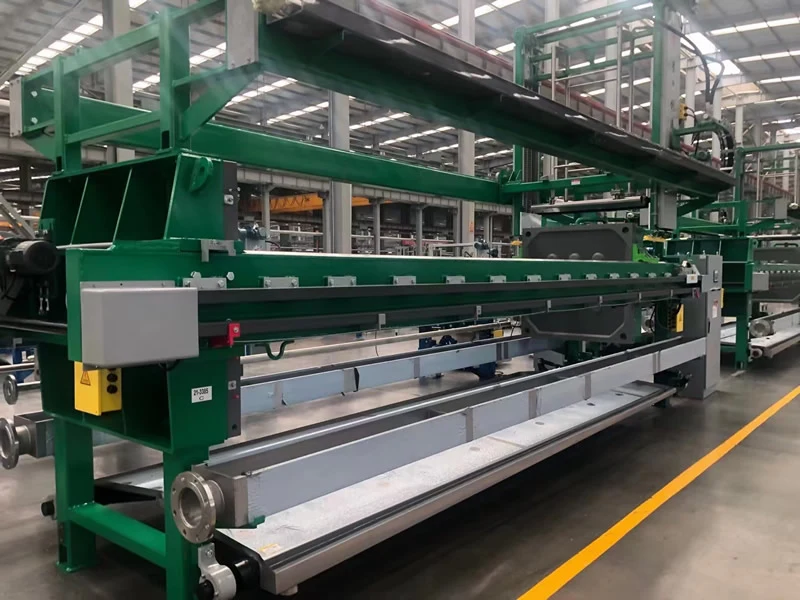
This is the most widely adopted and effective solution for modern tailings dewatering.
Working Principle: It builds upon a standard chamber filter press by integrating elastic membranes (rubber or PP) behind the filter plates. After the initial filtration phase, high-pressure water or air is injected behind these membranes, causing them to expand and apply a powerful secondary squeeze to the filter cake. This action physically compresses the cake, forcibly removing residual water from the pores.
Key Advantages:
Ultra-Low Cake Moisture: Achieves moisture content as low as 15%-25% or even less, enabling true "dry stacking" and cost-effective transport.
Energy Efficient: The mechanical squeezing process is more energy-efficient than methods relying solely on air blowing for dewatering.
High Automation: Capable of fully automated operation, including plate shifting, cake discharge, and filter cloth washing, minimizing labor requirements.
Ideal For: The vast majority of fine-grained and clay-rich tailings, such as from iron, gold, copper, lead-zinc, bauxite, calcium carbonate, and kaolin processing.
Selection Focus: Key parameters must be matched to tailings properties (particle size, density, viscosity), including required operating pressure (typically 1.0-2.0 MPa or higher), filtration area, and plate material.
Introducing Our Industrial-Grade Solution:
150 m² Power Heavy-Duty Diaphragm Filter Press | Fully Auto Unmanned System for Large-Scale Mining Operations
2. Chamber Filter Press (For Primary Dewatering)
Working Principle: Slurry is pumped into chambers formed by a series of filter plates. Solids are retained by the filter cloths to form a cake, while liquid passes through.
Pros: Simple design, relatively lower initial cost, and easy maintenance.
Cons: Relies solely on pumping pressure, resulting in a higher moisture content (typically 25%-35%+), which often fails to meet strict dry stacking criteria. Additional drying steps (thermal or natural) are usually needed, increasing cost and footprint.
Best Used For: Applications with less stringent moisture requirements, tailings with coarser particles and good permeability, or as a primary dewatering stage.
Introducing Our Industrial-Grade Solution:
3. Belt Filter Press
Working Principle: A continuous process combining gravity drainage, wedge zone pre-pressing, and pressure from a series of rollers.
Pros: Continuous operation, high throughput, smooth running, and generally lower capital investment.
Cons: Produces a cake with higher moisture content (28%-40%). Performance is poor for very fine, sticky tailings, with risks of cloth blinding. It also has higher wash water consumption and can create a wetter plant environment.
Best Used For: Tailings with good settling characteristics and coarser particles where moderate moisture is acceptable. Common in construction sand/gravel washing, coal refuse, and some mineral sands applications.
4. Plate & Frame Filter Press
Similar in concept to the chamber press but with thicker, sturdier plates and better sealing for higher pressure.
While suitable for applications requiring high pressure or involving special chemical properties, its role in modern tailings dry stacking has been largely superseded by the more efficient High-Pressure Membrane Filter Press.