
In the processes of industrial wastewater and municipal sewage treatment, sludge handling is a crucial step. Sludge from different sources possesses distinct physical and chemical properties, making the selection of suitable filter press equipment particularly important. This article systematically analyzes the characteristics of seven common types of sludge—municipal sludge, oil sludge, petrochemical sludge, textile dyeing sludge, paper mill sludge, tannery sludge, and electroplating sludge—and provides recommendations for corresponding filter press types and operational suggestions to serve as a reference for engineering selection.
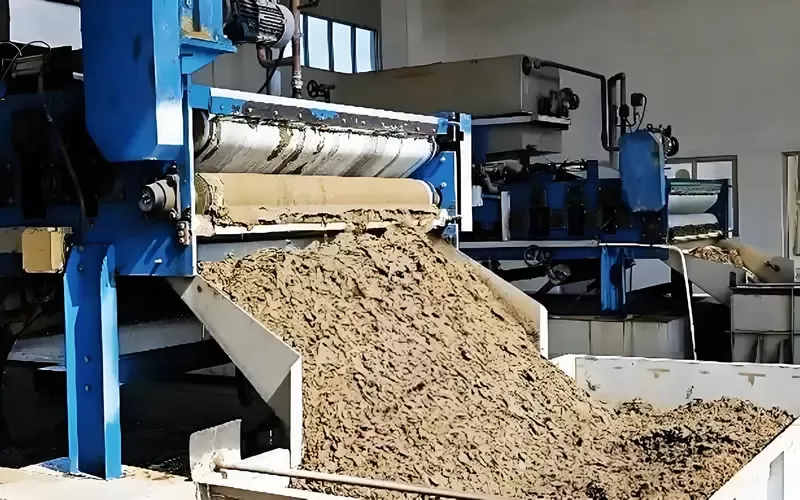
Sludge can be primarily categorized into two main types: municipal sludge and industrial sludge. Industrial sludge can be further subdivided, with complex compositions and varying treatment difficulties.
Characteristics of Various Sludge Types
| Sludge Type | Main Characteristics | Moisture Content (Before Dewatering) | Moisture Content (After Dewatering) | Special Components |
|---|---|---|---|---|
| Municipal Sludge | High organic matter, many pathogens, prone to odor | 95%–99% | 60%–80% | Heavy metals, parasites |
| Oil Sludge | Contains oil, high viscosity, low calorific value | 96%–99% | 70%–85% | Oil substances |
| Petrochemical Sludge | High sludge production, high viscosity | 96%–99% | 55%–85% | Hydrocarbon compounds |
| Textile Dyeing Sludge | High inert material, high heavy metal content | 95%–99% | 60%–75% | Dyes, auxiliaries |
| Paper Mill Sludge | High fiber content, high ash content, prone to clogging | 95%–99% | 60%–80% | Fibers, fillers |
| Tannery Sludge | Extremely high organic matter, contains sulfur and chromium | 95%–99% | 60%–75% | S²⁻, trivalent chromium |
| Electroplating Sludge | High heavy metal content, highly corrosive | 95%–99% | 55%–75% |
Recommended Filter Press Selection for Various Sludge Types
1. Municipal Sludge Treatment
Recommended Equipment: High-pressure diaphragm filter press, belt filter press
Reasoning: Diaphragm filter presses can reduce moisture content to below 60% through secondary pressing, making them suitable for subsequent incineration or landfill. Belt presses are suitable for high-volume, continuous operation scenarios. 120 m² Large Heavy-Duty Diaphragm Filter Press
Pre-treatment Recommendation: Conditioning with PAM-type flocculants.
2. Oil/Petrochemical Sludge Treatment
Recommended Equipment: Enhanced plate-and-frame filter press, high-pressure diaphragm filter press
Reasoning: Plate-and-frame filter presses offer good sealing and strong oil resistance. Diaphragm presses can further reduce oil content and moisture content.
Pre-treatment Recommendation: Heating or adding demulsifiers to improve dewatering efficiency.
3. Textile Dyeing Sludge Treatment
Recommended Equipment: Plate-and-frame filter press, high-pressure diaphragm filter press
Reasoning: Plate-and-frame filter presses provide high filtration pressure, making them suitable for fine-particle sludge. Diaphragm presses can achieve even lower final moisture content.
Filter Cloth Suggestion: Use filter cloth materials resistant to alkali corrosion.
4. Paper Mill Sludge Treatment
Recommended Equipment: Belt filter press, screw press
Reasoning: Belt presses are suitable for fibrous materials and have strong continuous processing capabilities. Screw presses are less prone to clogging and are easy to maintain.
Pre-treatment Recommendation: Install fine screens to prevent fiber blockage of equipment.
5. Tannery Sludge Treatment
Recommended Equipment: High-pressure diaphragm filter press, corrosion-resistant plate-and-frame filter press
Reasoning: Diaphragm presses offer good sealing, preventing the escape of harmful gases. Corrosion-resistant plate-and-frame presses can withstand sulfide and chromium corrosion.
Safety Suggestion: Equip with gas collection and treatment systems.
6. Electroplating Sludge Treatment
Recommended Equipment: Stainless steel plate-and-frame filter press, high-pressure diaphragm filter press
Reasoning: Stainless steel offers strong corrosion resistance. Diaphragm presses provide high dewatering rates, facilitating subsequent solidification treatment.
Environmental Requirement: Filtrate must be equipped with a heavy metal recovery system.