
In the brewing and beverage industry, filtration isn't just a process—it's a critical determinant of product quality, shelf stability, and operational efficiency. Choosing the right stainless steel plate and frame filter press can mean the difference between consistent brilliance and costly inconsistencies. This guide will help you navigate the selection process based on your specific operational needs and growth trajectory.
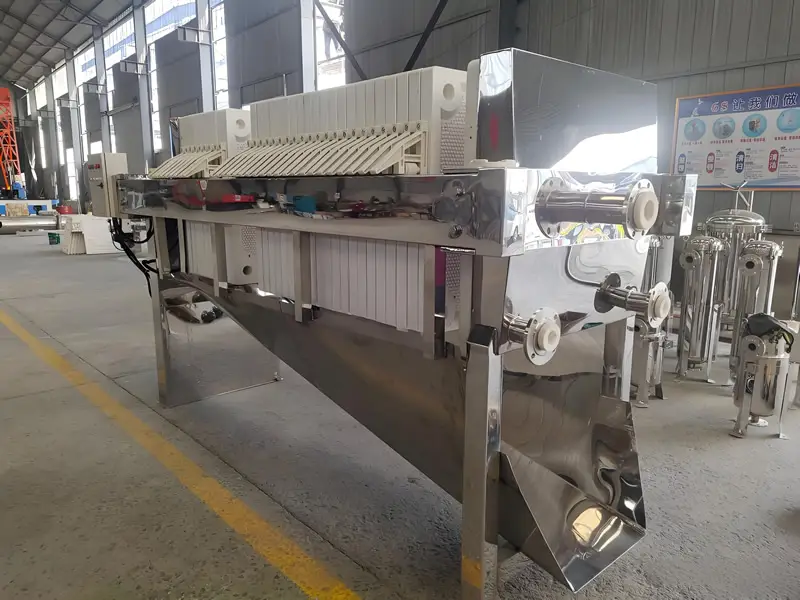
Your batch size determines everything. Consider:
Current daily/weekly production volume
Projected growth over the next 2-3 years
Peak season demands vs. regular production
Multiple product lines requiring different filtration setups
Different beverages demand different approaches:
Beer: Dry hop loads, yeast types, clarity requirements
Cider: Pectin content, fruit pulp levels
Specialty beverages: Viscosity, particulate size, chemical compatibility
Available floor space and ceiling height
Utility access (water, air, drainage)
Labor availability and skill levels
Budget considerations (both CAPEX and OPEX)
Recommended Specification: 10-Layer, 0.314 m² (3.38 sq ft) Precision System
For: Startup breweries, R&D facilities, experimental beverage producers
Why this fits:
Handles 5-25L batches perfect for recipe development
Precision controls ensure repeatable experimental results
Sanitary stainless steel construction meets research standards
Minimal space requirements fit laboratory environments
Our Recommendation:
Sanitary Stainless Steel Precision Lab-Scale Filter Press - Designed specifically for beverage R&D and sample preparation
Recommended Specification: 10-Layer, 1.25 m² (13.5 sq ft) Production System
For: Nano-breweries, startup beverage companies, small craft producers
Why this fits:
Processes 300-800L batches for commercial supply
Provides reliable consistency for brand-building
Efficient enough for daily production without over-investment
Flexible enough for multiple product types
Our Recommendation:
Small-Scale Production Filter Press - The ideal balance of capacity and flexibility for growing operations
Recommended Specification: 16---20 Layer, 2.0-2.5 m² (21.5-26.9 sq ft) Industrial System
For: Expanding microbreweries, regional beverage brands, contract manufacturers
Why this fits:
Handles 800-2000L+ batches for serious production
Higher automation reduces labor requirements
Built for continuous operation in commercial settings
Delivers economies of scale as production increases
Our Recommendation:
Fully-Automated Stainless Steel Industrial Filter Press - Engineered for high-volume brewing efficiency
Recommended Specification: 24---32 Layer, 3.0-4.0 m² (32.3-43.1 sq ft) Ultra-High-Capacity System
For: Regional breweries, national brands, large beverage plants
Why this fits:
Processes 2000-4000L+ batches for maximum throughput
Full automation minimizes operational complexity
Industrial-grade construction ensures reliability
Delivers lowest cost per liter at scale
Our Recommendation:
Sanitary-Grade Stainless Steel Ultra-High-Capacity Filter Press - The definitive solution for maximum-throughput operations